

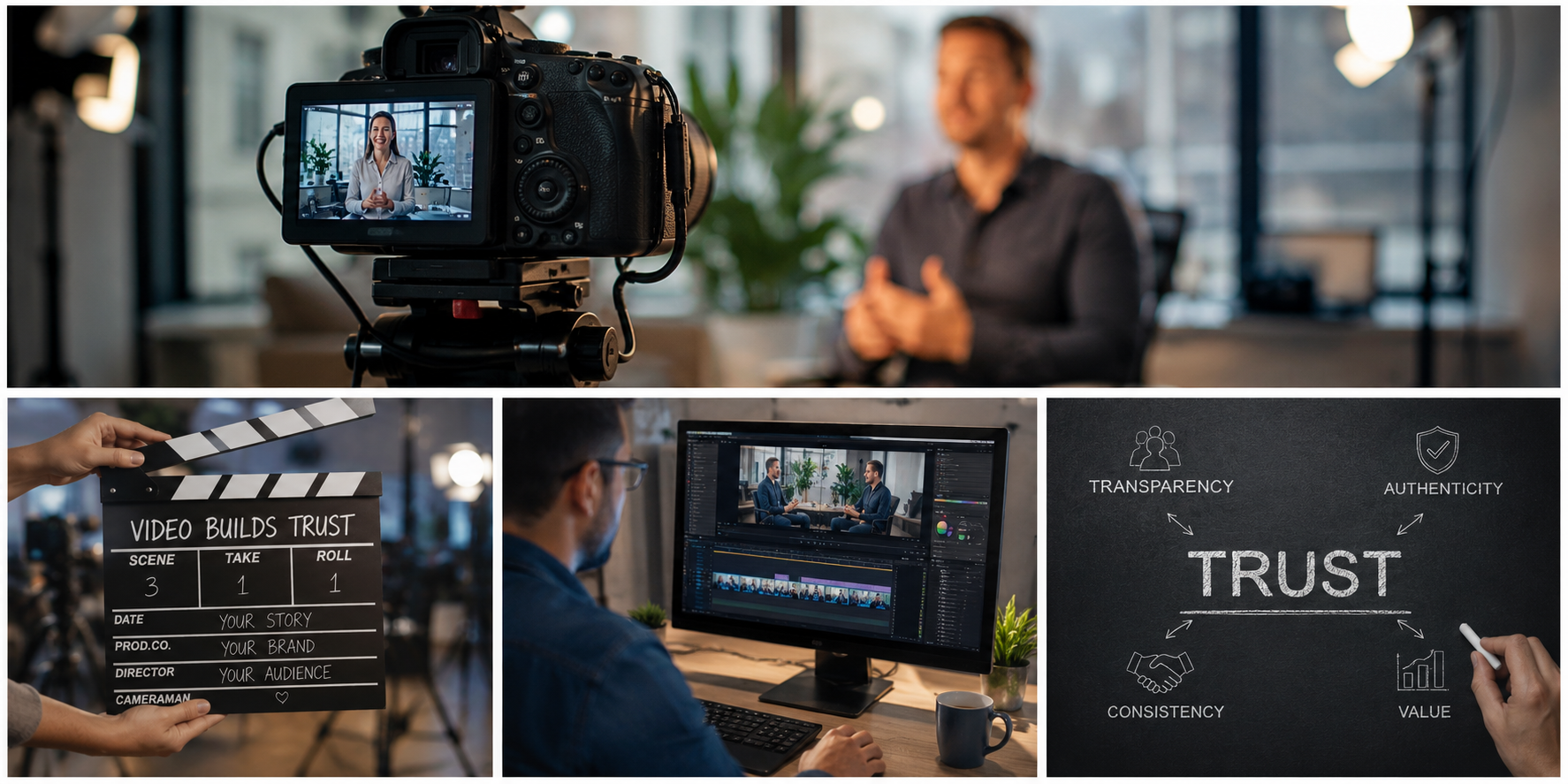
In a digital environment where businesses compete constantly for attention, visibility alone is no longer enough.
Customers, partners and decision-makers also want to know who they are dealing with. They want to understand the people behind a business, see evidence of its work and develop confidence before making contact.
This is where video has a particular advantage.
Unlike many other forms of communication, video allows a business to combine people, voice, environment, expertise and evidence in the same piece of content.
Used well, video does more than promote a company.
It helps people trust it.
Trust is becoming a business advantage
Trust has always mattered in business, but it has become increasingly important as customers are exposed to more digital content and AI makes content production easier.
For B2B companies in particular, purchasing decisions can involve significant budgets, several decision-makers and long-term relationships.
LinkedIn’s 2025 B2B Marketing Benchmark found that 94% of B2B marketers surveyed considered trust key to success. The research also found that marketers with mature video strategies were 2.2 times more likely to describe their brands as well trusted. (LinkedIn)
LinkedIn – B2B Marketing Benchmark: The Video + Influence Effect Starts With Trust
This suggests an important shift in how businesses should think about video.
The objective should not always be simply:
“How many people watched our video?”
A better question may be:
“Did this video give someone more confidence in our business?”
Show, rather than simply tell
Almost every company website contains similar claims.
Professional.
Experienced.
Reliable.
Innovative.
Customer-focused.
The problem is that saying these things does not necessarily prove them.
Video gives businesses an opportunity to show the evidence behind those claims.
A professional services company can introduce the people delivering the work.
A manufacturer can show its facilities and production process.
An architect can explain a completed project.
A healthcare organisation can introduce its specialists and environment.
An event company can show what actually happens behind the scenes.
A business can allow an existing customer to describe their experience in their own words.
This is fundamentally different from simply telling an audience that a company is trustworthy.
It provides something closer to visible evidence.
LinkedIn’s research into B2B video describes this as one of video’s advantages: it can make complex products and services easier to understand, evaluate and trust. (LinkedIn)
LinkedIn – Winning the B2B Buying Group with Video
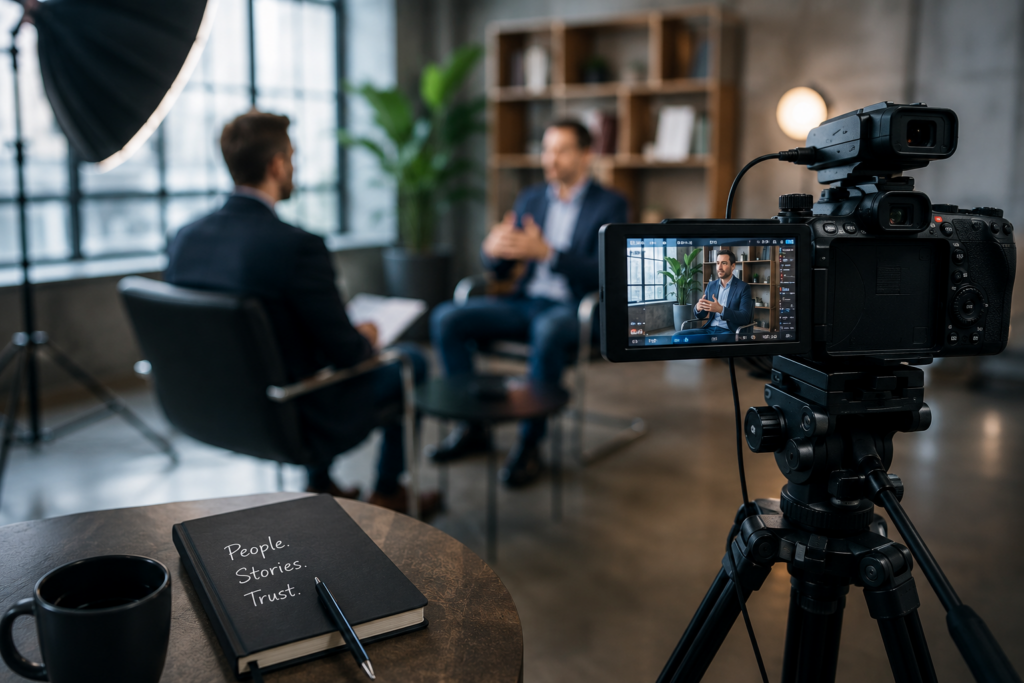
Put real people in front of the camera
One of the simplest ways businesses can build trust through video is also one of the most effective:
Let people see the people behind the organisation.
This could be a founder explaining why the company exists, a specialist discussing an area of expertise, an employee explaining how something works or a customer talking about their experience.
These videos do not always need complicated concepts.
What matters is that they feel credible.
For many professional businesses, particularly those selling expertise rather than physical products, people are a significant part of the product itself.
Before contacting a consultant, lawyer, property adviser, doctor, architect or agency, a potential customer may want to understand:
Who am I going to be dealing with?
Video can begin answering that question before the first meeting takes place.
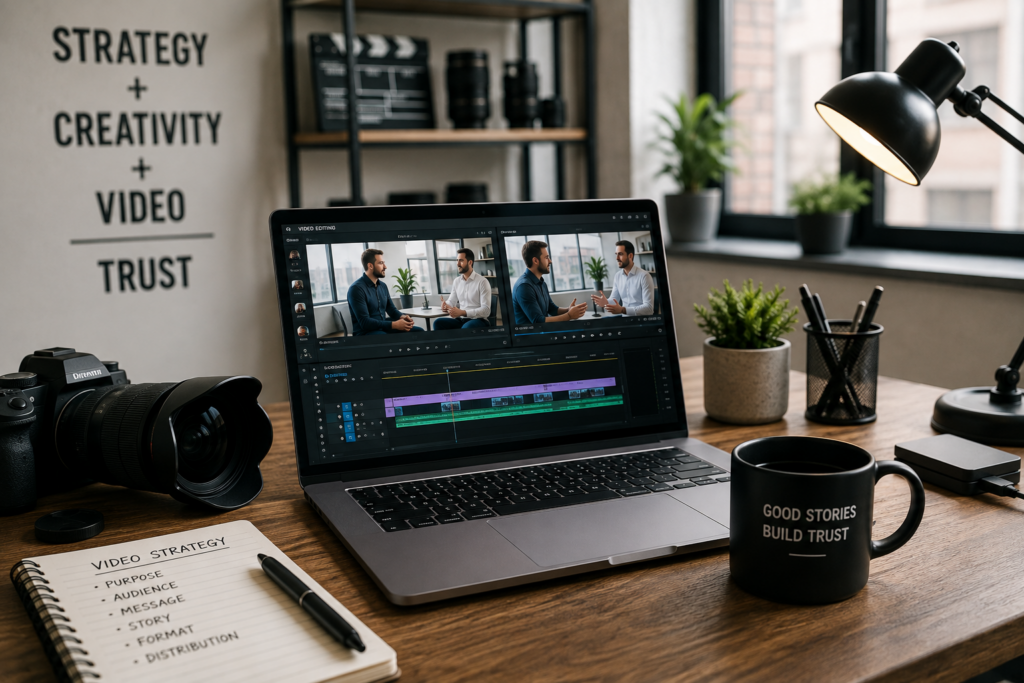
Explain what you do
Trust is closely connected to understanding.
If customers do not understand a company’s service, process or expertise, they may hesitate to engage.
This makes explainer videos particularly useful.
Wyzowl’s 2026 video marketing research found that 96% of people surveyed had watched an explainer video to learn more about a product or service, while 63% said short video was their preferred way to learn about one. (Wyzowl)
The same research found that 93% of video marketers said video had helped increase users’ understanding of their product or service. (Wyzowl)
Wyzowl – Video Marketing Statistics 2026
A useful business video therefore does not always need to sell.
Sometimes the most valuable thing it can do is simply explain.
Let your customers speak
Businesses naturally say positive things about themselves.
Audiences know this.
That is why customer stories and testimonials can be particularly powerful.
Instead of:
“We provide an excellent service.”
a real client can explain what problem they had, why they selected the company, what happened during the project and what result they achieved.
The business is no longer making the claim alone.
Someone else is providing the evidence.
For B2B businesses, case-study videos can be particularly effective because they combine several elements of trust:
a real customer + a real problem + a real project + a real outcome.
Quality matters — but authenticity matters too
Professional production quality is important.
In Wyzowl’s 2026 survey, 89% of consumers said video quality affects their trust in a brand. (Wyzowl)
Poor sound, distracting visuals or careless editing can therefore affect how a company is perceived.
But professional does not have to mean artificial.
In fact, an overly scripted corporate video can sometimes create distance between the organisation and the audience.
The strongest business videos often combine professional production with natural communication.
Good lighting.
Clear sound.
Strong composition.
Thoughtful editing.
But also real people speaking like real people.
The objective should not be perfection.
It should be credibility.
One video should not try to do everything
Businesses sometimes approach video production by trying to put their entire company into one three-minute corporate film.
There is another approach.
Think of video as an ongoing communication system.
A business might create:
- a short founder introduction;
- customer testimonials;
- project case studies;
- behind-the-scenes content;
- expert interviews;
- short educational videos;
- event coverage;
- employee stories;
- answers to frequently asked questions.
Each piece performs a different function.
Together, they gradually create familiarity.
And familiarity can help create trust.
This is particularly relevant on platforms such as LinkedIn, where professional audiences may encounter a company several times before ever visiting its website or making an enquiry.
AI will make authenticity even more valuable
Artificial intelligence is rapidly changing video production.
Wyzowl’s 2026 research found that 63% of video marketers had already used AI video tools to help create or edit marketing videos, up from 51% the previous year. (Wyzowl)
AI can make production faster and more efficient. It can assist with editing, transcription, translation, research, planning and content adaptation.
But as the volume of AI-generated content increases, businesses may face a new challenge:
How do audiences know what is genuine?
This could make authentic business video even more valuable.
Real founders.
Real employees.
Real customers.
Real locations.
Real projects.
Real expertise.
Technology can improve how these stories are produced and distributed. It does not have to replace the people and experiences that make those stories credible.
How we approach video at Piaryum
At Piaryum Communication & Media Ltd, we believe effective corporate video starts before the camera is switched on.
The first questions are not about cameras, lenses or editing software.
They are:
Who are we speaking to?
What do they need to understand?
Why should they believe this organisation?
And what is the most credible way to tell that story?
Our work across corporate filming, interviews, events, photography and media production has reinforced one principle:
Good production attracts attention. Good storytelling gives that attention meaning. And credibility turns communication into trust.
Technology will continue to change how video is produced.
The fundamental objective, however, remains remarkably human:
Give people a reason to believe in the business behind the screen.